
Why Parents Kill Their Own Family Members: Psychological and Social Causes
Parents Kill Their Own Family, Killing one’s own children and/or life partner remains one of the most traumatic expressions of violence because it goes against the fundamental biological and psychological urge of any human being to defend their family. In circumstances where such tragic events take place, society is left aghast as to how and why a parent and/or a life partner would infringe on this definite and irreversible moral line that divides a civilized human being from a savage animal that needs no laws to restrict its brutal nature. Cases such as those in Lahore’s DSP demonstrate that people with power and education are also not free from emotional breakdowns and that a family violence crisis is not exclusive to those with less power and education; on the contrary, it is clearly a manifestation of a pre cultivated psychological problem.
One of the major root causes of killing within families has to be domestic disharmony that has persisted for an extended period of time. In cases of relentless spousal incidents characterized by quarreling, lack of trust, anger, and emotional detachment, an accumulation of tension arises that, in turn, can build up into anger in one or both of the involved individuals. Perpetrators of spouse murder often confess that they “felt cornered or out of control” in the heat of rage, though this anger has had its roots for many years within these conflicting partnerships. In the situation of spouse murder that occurs in marriages that involve separation, divorce, or remarriage, jealousy, abandonment fears, or damage to social status can heighten spousal conflicts. In these cases, presumably innocent children can be caught in crossfire’s either because they can be perceived as an appendage of the spouse or in an attempt by perpetrators to cause maximum emotional pain to these spouses. Social psychologists verify that when anger has not yet abated for an extended period of time, but when combined with feelings of entitlement or dominance, “the risk of deadly outcomes accelerates.”
Lahore DSP case is a frightening example of what may result in catastrophic violence. In this particular case, a cop reportedly killed his wife and daughter before trying to fool the system by reporting a kidnapping case. It is alarming in this particular case because not only was he educated and financially well set, but it is even more frightening because he was trained in keeping the law in line. Evidence has a significant role in this particular case, in which it was seen that there were ongoing disputes between them due to his second marriage. In this case, it is very apparent that everyone, regardless of their position, is susceptible to questionable behavior, which may lead to catastrophe. It is also evident in this case that individuals in authority may use their position to hide crimes, which may cause immense suffering.
Another major reason for the killing of family members by parents and/or partners is financial difficulties and property related conflict. Financial resources have historically remained a source of discord within families, particularly in communities where property succession and joint family forms and conditionality’s of economic support result in an uninterrupted cycle of conflict. In many cases, anger and frustration stemming from being denied what one believes to be their right result in killing family members when anger and despair get the upper hand regarding property succession: parents killed by their children for property, property related access and control for financial gain for spouses and children killed in custody and/or dowry related disputes. In these instances, the family tie of affection takes second place to greed and despair.
Mental health is an extremely important but misunderstood element of family tragedies of this kind. Severe depression, psychosis, personality disorders, and addiction can cloud judgment and emotional control. Some of the parents, who kill their children, suffer from psychotic episodes wherein they think they are shielding their children from danger or from a world not kind enough to them. Some suffer from clinical depression, wherein, according to psychological terms, they commit an altruistic filicide. Here, the perpetrator of filicide believes their child is better off dead than alive. Mental health in many cultures is generally tarnished, which deters them from seeking any professional help for their condition and, as a consequence, their condition deteriorates, resulting in death, in some cases.
Jealousy and possessiveness are also major motivations for family related violence. For instance, if one partner in a relationship thinks that the other is being unfaithful or might elude control, then resorting to violence becomes one way of dominating the partner. This has been common in situations where women want freedom and either divorce or remarry. In such situations, the children can either be victimized as a symbol of a partner’s freedom or as a means of ensuring that the partner never heals since they will never have any children to carry on their name since they have all been killed. This happens because they view family members as property as opposed to human beings who have rights.
The issue is further complicated by an array of cultural and so called honor related beliefs. There are cultures where the honor of the family is considered to be more valuable than the life of an individual. When an individual brings shame to the family, actions that could be classified as honor killing have been taken. Honor killings are mostly perpetrated by the distant members of the family; however, parents and spouses have also been known to carry out these killings. The actions are not an issue of honor they are basically about control and fear of being judged. The normalization of these values makes the process of prevention even difficult, as the offender will feel that he or she is doing the right thing. Despite the tough laws imposed on each nation, the social values continue to fall back.
A very worrisome feature of familicides is the use of control and power. Many of these offenders use control well before resorting to violence. They could deprive their partner of liberty, control her mobility, deny her financial autonomy, and threaten her. As control is lost, violence becomes a last resort to regain control. In cases where there are children, offenders may perceive children as an extension of themselves rather than as autonomous individuals. Such offenders find it easier to hurt children if they perceive control and authority as being challenged either by society, spouses, or children themselves. Such offenders are less sane and less rational, and thus, there is less need for a trial. Substance abuse is another major cause of family violence. Alcohol and drugs affect judgment and amplify emotional elements such as anger and jealousy by reducing inhibitions. Many domestic homicides are committed while the perpetrators are under the influence of alcohol and drugs, increasing incidents of lethal confrontations that arise from disputes that may have been avoided through sober reasoning and counseling.
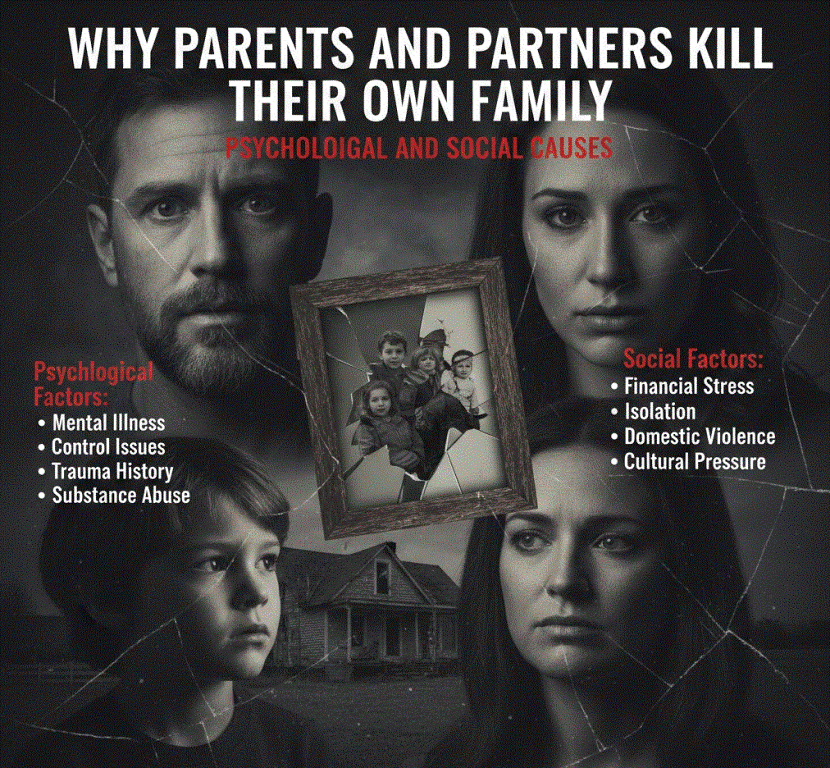
However, the addiction of individuals is usually considered a moral deficiency that is merely treated by refusing the individuals medical assistance for enhanced treatment. The cover up of these crimes, as evident in the case of the Lahore DSP, introduces a further psychological dimension. Giving false statements to the police, hiding bodies, and concocting explanations not only reveal their knowledge of the crime but also their confidence in their capacity to manipulate the system. Such aspects of their conduct are a manifestation of their narcissistic and non caring attitude toward society, where their own image and reputation become far more significant to them than the loss of life. It is absolutely crucial to highlight the fact that despite the gravity and horrific nature of these offenses, they are certainly not inevitable events.
The truth is, intervention and prevention are possible and lead to the saving of many lives. Unbeknownst to many, the warning signs of domestic and relationship abuse, and ultimately, of these violent events, include escalating violent domestic episodes, verbal and direct death threats, the obsessive need to control, drastic mood changes, and statements of hopelessness and revenge. Sadly, the aforementioned are commonly overlooked due to the stigma and connotations of embarrassment and disbelief in the judicial process. Another important factor is related to the judiciary and law enforcement. If complaints of domestic violence are ignored or downplayed, it only encourages the offender, and the survivor loses confidence in the safety network. However, effective and just law enforcement ensures that the offender knows that violence is not acceptable under any circumstances and that no matter who the offender is, violence will not be tolerated. The Lahore DSP case clearly shows the relevance of accountability, particularly involving powerful people. If powerful individuals commit acts of violence like this, the reaction has to be clear and firm. In conclusion, parents and spouses kill members of their own family owing to a combination of emotional, psychological, social, and cultural factors. Violence in the house, money problems, mental issues, jealousy, control, drug abuse, and destructive cultural ideologies create a setting wherein violence becomes probable. Real life situations such as the incident involving the Lahore DSP remind us that such disasters can happen to any class of society and that power and education are no deterrents against moral decay. Rather, acknowledgment of such factors is not a justification for the crime it is a call for attention to failings at the systemic level.
About the Author