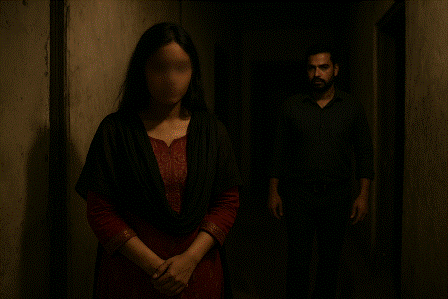
Prostitution in Pakistan is a multifaceted and entrenched social reality that persists far beyond the lens of morality or law. Prostitution is technically illegal under the laws of Pakistan and widely disapproved by cultural and religious mores. But it still exists in several layers nationwide from the most overt red-light districts of Lahore’s Heera Mandi to clandestine elite escort rings running through encrypted social media sites. Prostitution in Pakistan must be understood in economic, psychological, cultural, religious, legal, and digital terms because it is as much a body business as it is a measure of society’s hypocrisy, inequality, desperation, and silence.
At the core of this issue lies poverty and survival. For thousands of women, prostitution is not a choice of pleasure but a choice of survival. Widows, divorced women, single mothers, and even young girls forced by their own families enter this industry because the Pakistani economic system provides limited opportunities for women, especially those from lower income backgrounds. Home-based labor and sweatshop jobs offer meager wages, while prostitution provides immediate money usually the difference between a meal or starvation for whole families. In some heartbreaking instances, it isn’t women opting for this option its poverty opting for them.
Pronouncing judgment from a sympathetic and human rights perspective is necessary in order to see the human cost of prostitution in Pakistan. Behind each woman, child, or even man caught in this cycle exists a story, usually full of exploitation, betrayal, trauma, and survival. A number of women engaged in prostitution account for how they entered the sex world not by choice of desire but by way of abandonment, financial desperation, sexual abuse, or manipulation. In many instances, it starts with the family members most often fathers, brothers, or husbands selling or coercing women into these circuits. Others are lured by fake offers of work or marriage, which lead them into brothels or private guest houses.
Most women in prostitution are victims of child sexual abuse, never healing psychologically, and ultimately finding themselves in circumstances where exploitation seems the natural consequence of the injustice they already experienced. Seen in this context, prostitution is not so much about sinfulness and more about a breakdown in society’s ability to safeguard its women and children. The tragedy is compounded by the fact that these women usually have no place to run — they are rejected by society, used by police, and the same men who ask them out at night publicly humiliate them in broad daylight.
One of the hardest realities is the hypocrisy of society about prostitution in Pakistan. The same society that vociferously denounces this act sometimes invoking religion as a judgment tool tends to overlook the reality that the demand overwhelmingly originates from men from all classes, including business leaders, politicians, religious leaders, and even students from respectable families. Prostitution women always comment, “We are not the problem the men knocking on our door are.” But the whole weight of shame rests with the woman alone, while the men leave reputational unscathed.
Prostitution today in Pakistan is no longer confined to the old red-light zones such as Heera Mandi or Napier Road. It has moved swiftly into cyberspace, thriving discreetly on WhatsApp groups, Snap chat, Telegram, TikTok, private party networks, and upscale hotel cliques. Prostitution exists today in multiple layers from poor women ensnared in dingy inner-city slums to upscale ‘call girls’ commoditized as influencers or exclusive party hosts. These elite networks are often protected by political and financial power, making them untouchable, while only the poor are raided and humiliated.
Even in its illegality, the police seldom operate with justice. Police raids tend to be selective not to destroy the act, but to extort bribes, suppress cases, or even exploit vulnerable women. Women in most cases are arrested and imprisoned, with men involved including clients not suffering any legal penalties at all. Such selective criminalization shows the system protects demand and punishes supply.
From a human rights point of view, Pakistani prostitution cannot simply be considered a crime to be eliminated, but as a symptom of more profound systemic injustice poverty, illiteracy, gender discrimination, domestic violence, and lack of state protection. Any genuine solution would start with protection, rehabilitation, education, and economic empowerment, not punishment or sermonizing. These women are owed dignity, security, and an opportunity to rebuild themselves, not judgment.
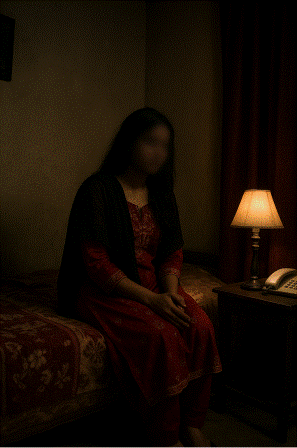
Solutions & The Way Forward
In order to bring about significant change, Pakistan needs to transition from a punishment culture to a protection culture. Prostitution cannot be eliminated through violence it can only be minimized by removing the grounds for which women are driven into it. Real reform starts with economic justice, legal protection, and social acceptance of rehabilitation.
The strongest solution is economic independence. The state and NGOs must actively provide skill-based training, microfinance loans, and respectful employments so that women are never compelled to sell their bodies to survive. A woman who has access to equitable work, secure shelters, and earnings is much less exposed to exploitation.
1. Economic Empowerment for Women
2. Safe Rehabilitation & Protection Centers
Rather than police raids shaming and jailing women, what Pakistan requires are government-supported rehabilitation centers that provide counseling, vocational training, legal services, and safe shelter. Such facilities must be operated with dignity, confidentiality, and no judgment whatsoever. Women should be treated not as offenders but as survivors of failure by society.
3. Strong Laws to Punish the Demand Side
It is not fair that the women get punished whereas the men who provide the demand go scot free. Laws have to strictly target the buyers, traffickers, and exploiters, such as brothel owners, online agents, and crooked cops. Actual reform starts when the men facilitating exploitation are brought to book, not merely the women just managing to survive it.
4. Education at the Root Level
In order to avoid future generations committing this cycle, there need to be very intensive campaigns in schools, media, and the rural areas advocating gender equality, moral accountability, and compassion. Society must learn that a woman’s worth lies in her humanity rather than purity.
5. Islamic Framework of Mercy & Rehabilitation
Although Islam strictly forbids prostitution, it also instructs society to guard the oppressed, to give economic support to orphans, widows, and needy women, and not to humiliate them in public. An Islamic solution is not punishment and humiliation but rather mercy, justice, and restoration of honor.
6. Breaking the Social Stigma
Even if women attempt to exit prostitution, society excludes them. Pakistan needs to normalize rehiring and reintegrating these women into the workplace with no judgment or discrimination. Media and influencers can help to shift public opinion these women are not sinners, they are survivors.
Ultimately, prostitution in Pakistan isn’t merely a moral problem it is a human rights emergency. The true triumph will be not when prostitution is kept out of view, but when no woman is ever led into it again.
A Real Story the Voice of the Silenced
Farah was just 16 when her father passed away, and she, her mother, and her two younger brothers were left with no money and no help from their relatives. A relative had promised her a work opportunity in a beauty parlor in a nearby city. In actuality, she was sold to a private guest house. Her first night was not a decision it was a rape. She wept every night for months but did not speak, because every rupee she earned kept
Role of Social Media Driving a New Silent Market
Social media has become Pakistan’s biggest unofficial red-light district quietly. Snapchat, WhatsApp, TikTok, and Instagram are utilized to advertise, organize, and bargain for prostitution services without ever venturing onto the street.
“Private story” Snapchat provides.
“Modeling / sponsor required” TikTok DMs.
Instagram accounts claiming to be “makeup artists / escorts.”
WhatsApp “VIP lists” shared with amongst affluent clients.
This is simpler, more clandestine, and more lucrative than the old brothels. Unfortunately, even teenage girls are victims usually deceived, coerced through blackmail, or enticed for easy money.
How the State is Responding Efforts & Limitations
The Pakistani state has made some visible efforts, but they tend to be superficial and transient.
FIA cybercrime wings do make raids on virtual prostitution rings.
Police do sometimes close clandestine brothels and guest house routines.
New cyber legislation is attempting to control online trafficking.
But there is no rehabilitation system in the long term. The woman is penalized by law, while the agents, purchasers, and virtual mafias who are behind her are neglected. The state needs to shift from arrest and raids to rescue, reintegration, and protection only then can eradication be achievable.
In the center of Pakistan’s urban cities and neglected small towns, a silent crisis lies not a moral one, but a human one. Prostitution in Pakistan is not a tale of sin, but of survival, exploitation, poverty, and selective morality of society. As the world haggles over religion and culture, thousands of women are held captive between hunger and humiliation, leading lives the world will not see.
While society plays hypocrite in the background holding vigourous debates over religion, culture, and morality, and turning a deaf ear to their actual agony. They exist in obscurity, silent and unmentioned, as people do not want to see their agony — for if they close their eyes, the issue will go away.
“You judge them without ever understanding their pain. This is not about sin it is about survival.”
About the Author