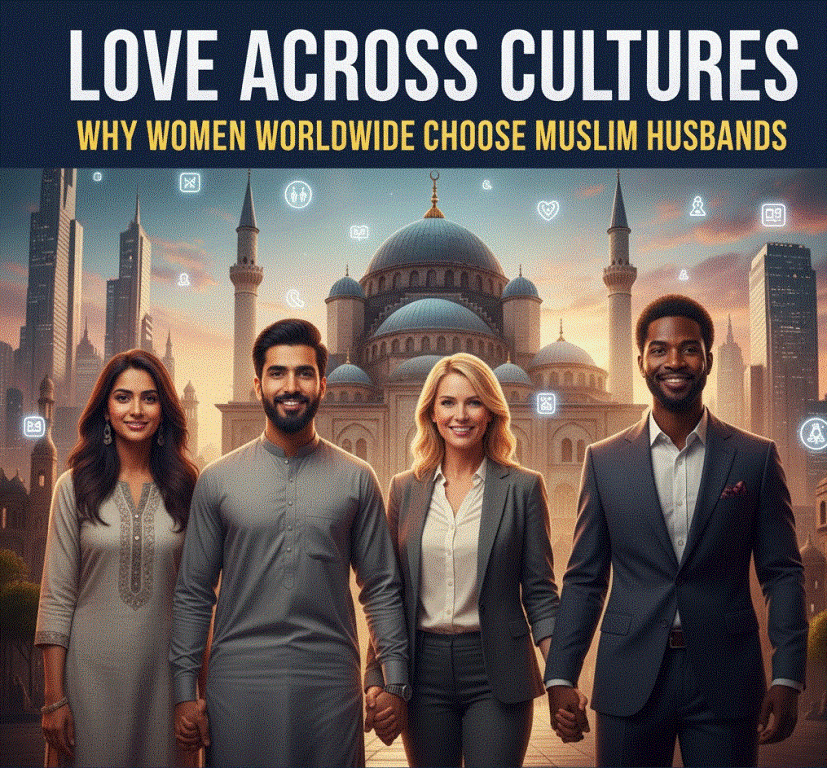
Many women worldwide are showing rising interest in marrying Muslim men: (A Social Media Discussion Review)
Online discussions, social media posts, many anecdotal stories, and even some informal surveys that have cropped up in recent years suggest that women from other regions whether Western countries like Europe and North America or Asian countries like the Philippines, India, Nepal, and Thailand are increasingly open to the possibility of considering Muslim men as marriage mates. This is a widely floated idea, but one that needs to be taken with a grain of salt, since human relationships can never be packaged in neat generalizations or universal rules. The perception itself, however, is not insignificant and thus begs questions like: Is there indeed a growing trend of cross cultural interests in Muslim men? And if so, for what reasons? Rather than assumptions or stereotypes, this dynamic requires a thoughtful sociological perspective.
First, let me clarify that global marriage patterns have dramatically shifted in the last two decades. With the rise of social media, international travel, digital communication, and cultural globalization, today’s people interact across borders in ways unimaginable to any previous generations. Young men and women meet through international universities, work environments, online platforms, gaming communities, language exchange apps, and even TikTok or Instagram. This, in turn, leads to more cross cultural friendships, relationships, and marriages. It is within this landscape that Muslim men—coming from diverse cultural backgrounds of Arab, South Asian, African, and Southeast Asian communities have become increasingly visible online. Many non Muslim women, therefore, encounter Muslim men in digital spaces where personal qualities and cultural values weigh more than geographic proximity. A rise in visibility can be mistaken for a “trend” even though it’s hardly a universal phenomenon.
Another contributing factor to this perception would be the global interest in Islamic culture driven by the spread of media content whether it be Turkish dramas, Arab vlogs, Pakistani romantic serials, and even Malaysian or Indonesian lifestyle influencers. These shows often portray Muslim men as respectful, family oriented, emotionally expressive, and protective again, qualities that appeal to many viewers regardless of their own cultural background. While fictional portrayals are not reliable indicators of real life behavior, media undeniably shapes romantic expectations. Women who admire these traits might generalize them to Muslim men broadly, developing curiosity or admiration for the cultural values associated with Muslim majority societies. This is the same dynamic through which the popular Korean dramas influenced international perceptions of Korean men and how Western movies shaped international notions of Western romance. The perception of Muslim masculinity portrayed through media has become soft, romantic, and dignified, revising many previously negative stereotypes and replacing them with images of responsibility and emotional loyalty.
Besides media influence, many women find themselves drawn to what they see as strong family values among Muslim men. In most Islamic cultures, the family is a core issue in social life. Marriage is treated and regarded as a serious institution rather than a casual decision. A Muslim man from a traditional background will be brought up with the expectation that he offers emotional, financial, and social stability to his wife. To women who have grown up in a society where relationships are often temporary, casual, or individualistic, this seriousness can be appealing. What they find most attractive is the promise of commitment, long term stability, and a family centered lifestyle one that coincides with their own values or future expectations. Whether such values are universal among all Muslims or not is completely irrelevant. What matters is the perception, which influences attraction and interest.
A related reason is the increasing global conversation on modesty, loyalty, and respect within relationships. Many women feel dissatisfied with modern dating cultures centered on superficial interactions, temporary arrangements, or a lack of commitment. The respectful communication, avoidance of explicit behaviors, or interest in marriage over casual dates from Muslim men create a feeling of emotional security when women encounter these attitudes. Online discussions frequently refer to the fact that some Muslim men seem more respectful in their form of communication objectification avoided, boundaries considered, and genuine care taken in talking to a partner. This respectful attitude, whether it is widespread or situational, creates a memorable contrast for women who have experienced toxic or disrespectful interactions in their dating environments.
Another significant factor is curiosity and openness toward Islam itself. Many women who get to know Muslim men become interested in the religion because of discussions on lifestyle, values, spiritual depth, or philosophical questions. Islam’s emphasis on discipline, prayer, charity, responsibility, and respect for parents may appear attractive especially to those women who feel their lives are without purpose or structure. It is not unusual for individuals to get interested in a religion through personal relationships, which happens in various religions worldwide, not just Islam. Statistical studies have shown that marriage is often an important factor that can influence religious exploration. As a woman gets interested in a Muslim man, she may also explore his culture and religion, which may make her admire or even convert to it. This can make the relationship deeper and more meaningful, reinforcing further that Muslim men represent stability, spirituality, and purpose.
Additionally, cross cultural marriage trends are shaped by both economic and social factors. In some Asian regions, women seek partners offering them better financial stability or greater respect for marriage commitments. Muslim men who work abroad, particularly in the Gulf countries, Europe, or North America, interact with various ethnic groups of women. These interactions can lead to long term relationships. In some cases, women from developing regions admire the economic stability and responsible nature of Muslim professionals they meet abroad. On the other hand, women from developed countries sometimes express appreciation for the emotional warmth and dedication that Muslim men display, quite unlike the often more individualistic dating norms common in Western societies. These exchanges create a bridge between cultures where mutual attraction becomes more common.
Another contributing factor is the admiration for cultural diversity. Many modern women appreciate partners who bring unique cultural traditions, languages, and histories into a relationship. The richness of Muslim majority cultures from Arabic hospitality to South Asian family traditions adds a certain depth and identity to marriage. Women who enjoy multicultural experiences often find these traits appealing. Lastly, many Muslim men retain close family relationships, creating a great sense of belonging and support for women who value community life. Of course, this can also introduce challenges; however, for many women it’s a refreshing alternative to cold or disconnected family structures. One must not overlook the power of social media trends. Platforms like TikTok, Instagram, and YouTube have built a world stage on which young Muslim men share lifestyle content: fashion, fitness, travel, cooking, humor, religious reflections, and interactions with family. Online personas often emphasize traits desirable to people of any faith, including kindness, confidence, humility, and responsibility. Comments by women abound, declaring interest, admiration, or attraction. Viral content exaggerates the perception of a “trend,” but it can make that trend seem universal when it is actually representative of only a slice of worldwide relationships. Still, such visibility reinforces the message that many women find Muslim men appealing. However, it is important to understand the complexity that underlines this view. Not all women are attracted to Muslim men, and not all Muslim men live up to their positive descriptions on the internet. Individuals are shaped by personality, upbringing, education, and personal values more so than by religion. Marriages across different cultures come with their own set of problems, such as language barriers, cultural differences, family expectations, and lifestyle adjustments. While attraction may stem from idealistic notions, successful relationships require deep emotional compatibility, communication, and mutual respect. Another point worth mentioning is that some of these “trends” could easily be exaggerated due to online echo chambers. A few viral posts or popular opinions could create an illusion of universal preference. Then again, women who prefer Muslim men are perhaps more vocal on the internet, which contributes to the perception of growth. Sociologically, trends spread faster when people share them publicly, even though the actual number remains at a minor percentage level relative to global population. In the final analysis, the notion that women of different regions are increasingly opting for marriage with Muslim men cannot be generalized as a fact but is not entirely an illusion either. There is definitely a marked increase in the cross cultural relationships involving Muslim men due to globalization, cultural visibility, media portrayals, family values, and the admiration of certain personal traits. This trend mirrors broader global shifts in communication, expectations of lifestyles, and relationship dynamics. At the end of it all, attraction is deeply personal, and it varies from one individual to another. But the growing interest from curiosity to admiration indicates that Muslim men increasingly become visible and appreciated on the world stage. What really matters in any relationship regardless of religion or nationality is mutual respect, understanding, and sincere connection.
About the Author