The Future of Education
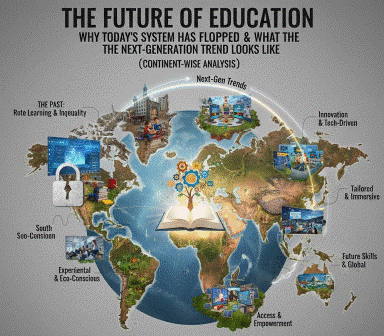
What was once thought to be the backbone of global development, the modern educational system, is now viewed by many as outdated, rigid, and grossly inadequate to equip students for the challenges of tomorrow. Based on an industrial era model that focused on memorization, standardization, and strict structures, today’s frameworks of education have utterly failed to keep pace with the changes besetting the AI driven, rapidly shifting digital world. Students on every continent increasingly are disengaged; employers in every industry report skill gaps widening; and parents wonder whether formal schooling prepares children for real challenges. This growing global frustration has experts arguing that the system has “flopped,” pushing nations to rethink what learning truly should mean for the next generation.
The primary problem of today’s global education system is that it grounds itself on theoretical learning instead of practical skills. It is common in most schools to stress memorizing textbooks rather than solving real problems. Furthermore, obsolete exams and rigid curricula have changed students into passive recipients of information rather than active learners who think, question, and innovate. With technology reshaping careers, traditional schools have also failed to adapt quickly. Even the subjects taught today often have little relevance to emerging professions, many of which require digital literacy, creativity, entrepreneurship, and adaptability skills the present system barely touches. This systemic weakness has also been highlighted by the rise of mental health concerns, lack of personalization, and inequality in access to quality resources. For these reasons, countries across the world have instituted reforms in education, yet differing in pace and priorities across the continents. This has led to a continent wise debate on what a next generation educational system should look like.
In Asia, where education has traditionally held significant cultural value, a dramatic transformation is underway. With rapid economic growth and technological development, Asian nations have been forced towards hybrid and AI driven learning concepts. Giant economies like China, India, Singapore, and South Korea are implementing AI in classrooms to offer customized learning based on the speed and abilities of each student. AI tutors, homework automation systems, and real time analytics of learning gain momentum. Another significant transition underway in Asia is from rote learning to skill based education. India’s New Education Policy reflects this transition amply with the inclusion of coding, robotics, digital literacy, financial planning, and entrepreneurship from the early grades onward. At the same time, China’s EdTech ecosystem is considered one of the fiercest in the world, with platforms offering AI powered adaptive learning. Online micro degrees and short term certifications from global technology giants like Google, Amazon, and Ali baba Cloud have gained significant momentum, signaling a shift away from rigid four year degrees. A combination of digital learning, practical training, and entrepreneurial thinking will arguably characterize the growth of the next generation in Asia.
In Europe, this transformation focuses on personalization, creativity, and sustainability. European education systems, especially in Nordic countries like Finland, Norway, and Denmark, grant enough freedom to students to focus on their autonomy, emotional well being, and project based learning. They are globally acknowledged to reduce standardized tests to a bare minimum and instead encourage students to learn interdisciplinary subjects instead of just memorizing scattered facts. The next generation model of Europe gives great emphasis to environmental education since climate change is making a crucial impact on the continent. On a quotidian basis, students would be studying renewable energy, sustainable agriculture, and eco innovation. Besides that, European schools are very serious about social and emotional learning. Skills such as empathy, collaboration, communication, and emotional intelligence equally matter as academic subjects. It also endorses lifelong learning with the help of government funded programs for up skilling and digital learning platforms. Education in the continent is thus becoming more flexible and centric towards students, where well being assumes equal importance with academic performance.
The North American region, led by the United States and Canada, is arguably one of the most technologically driven transformations. Classrooms are increasingly powered by artificial intelligence, virtual reality, and gamified learning systems. AI assistants help students grasp complex topics while predictive analytics offer teachers tools to identify learning gaps. North America also lays strong emphasis on creativity, innovation, and debate based learning. There is much encouragement for students to think independently, question systems, do research, and come up with original ideas a method that has fueled a long tradition of innovation and entrepreneurship. Another major trend reshaping North American education is the explosive rise of home schooling and remote learning. Many families have shifted toward personalized learning models that emphasize mental health, flexibility, and individual pacing. EdTech startups like Khan Academy, Coursera, Skillshare, and Udemy have become big forces, offering alternative learning trajectories that compete with traditional education. North America’s emerging education model is therefore a balance between digital sophistication, independent learning, and creative exploration.
In South America, the focus is on reducing inequality and increasing digital access. Most countries of the region face huge urban rural divides, which next generation education strives to bridge through digital inclusion. Governments in Brazil, Chile, and Argentina have engaged in tablet distribution, free internet access, and cloud based learning platforms. Community based models of education are also growing in strength, where schools work in cooperation with local communities to teach practical, relevant skills related to local economies. Sustainable farming, cultural heritage, craftsmanship, and social entrepreneurship are finding their place in school curricula. Given the linguistic diversity of South America, there is a recognition of the value of multilingualism. The bilingual and multilingual programs have become common, way beyond the elementary school level, for young learners to become global citizens. Finally, the region is moving from inflexible, rote memorization learning to project based learning that includes teamwork and the solving of real life problems.
African continent
Next generation education is urgent and transforming on the African continent, where the population remains the world’s youngest. Innovation was catalyzed by relative access to traditional schooling, especially on mobile based learning. With increasing Smartphone penetration, mobile apps, SMS lessons, and radio and TV programs have become increasingly used mediums for African students. Entrepreneurship learning is also a core element of reforms in African countries where unemployment continues to be one of the major issues. There is a greater emphasis on practical skills such as agriculture innovation, small business management, vocational training, and digital entrepreneurship. Affordable EdTech solutions are emerging across the continent, recognizing the need for offline learning and solar powered digital classrooms. Countries like Kenya, Rwanda, Ghana, and South Africa are leading when it comes to integrating AI and other digital tools into learning, with a vision for low cost education accessible to all and future ready. The model emphasizes pragmatism, mobility, and innovation geared toward local needs in Africa’s version of next generation education.
Australia and Oceania bring yet another perspective into the world’s debate on future education. Australia and New Zealand are focusing on flexibility in learning pathways, enabling students to combine skill based electives, industry integrated courses, and interdisciplinary subjects. A striking characteristic of education in Oceania is a good balance between digital learning and outdoor, experience based education. Nature based activities, cultural knowledge, and indigenous wisdom have been integrated into mainstream education through schools, thus creating an immersive and culturally respectful environment in which one learns. Mental health support is considered an important component, where schools provide counseling, mindfulness programs, and anti bullying initiatives. What the Oceania approach shows, however, is that education must not just encompass advanced technologies but also include well being, cultural identity, and being in touch with nature.
Across all continents, a range of global trends unites the next generation educational movement in a number of ways. Artificial intelligence and personalized learning systems are fundamentally changing the way students study, allowing them to learn at their own speed through adaptive technologies. Skill based education has replaced the traditional method of memorization, and with the rapid development of digitalization, more and more importance is given to critical thinking, creativity, collaboration, and digital literacy. Microlearning and nano degrees short, focused certifications are vital for career development, especially in fast changing job markets. Gamification and immersive learning through virtual and augmented reality are rapidly changing classrooms into active digital spaces. Hybrid and online learning models have made education more flexible than ever, enabling students to study anywhere and at any time. On the other hand, emotional intelligence, mental health, and global citizenship are becoming vital parts of modern curricula. These universal trends stress the fact that education needs to prepare learners not only for employment but also for responsible and empathetic global citizenship. The world is undergoing an education revolution. The traditional regime that earlier dictated global learning can no longer sustain the demands of a world driven by rapid technological change, globalization, and evolving career structures.
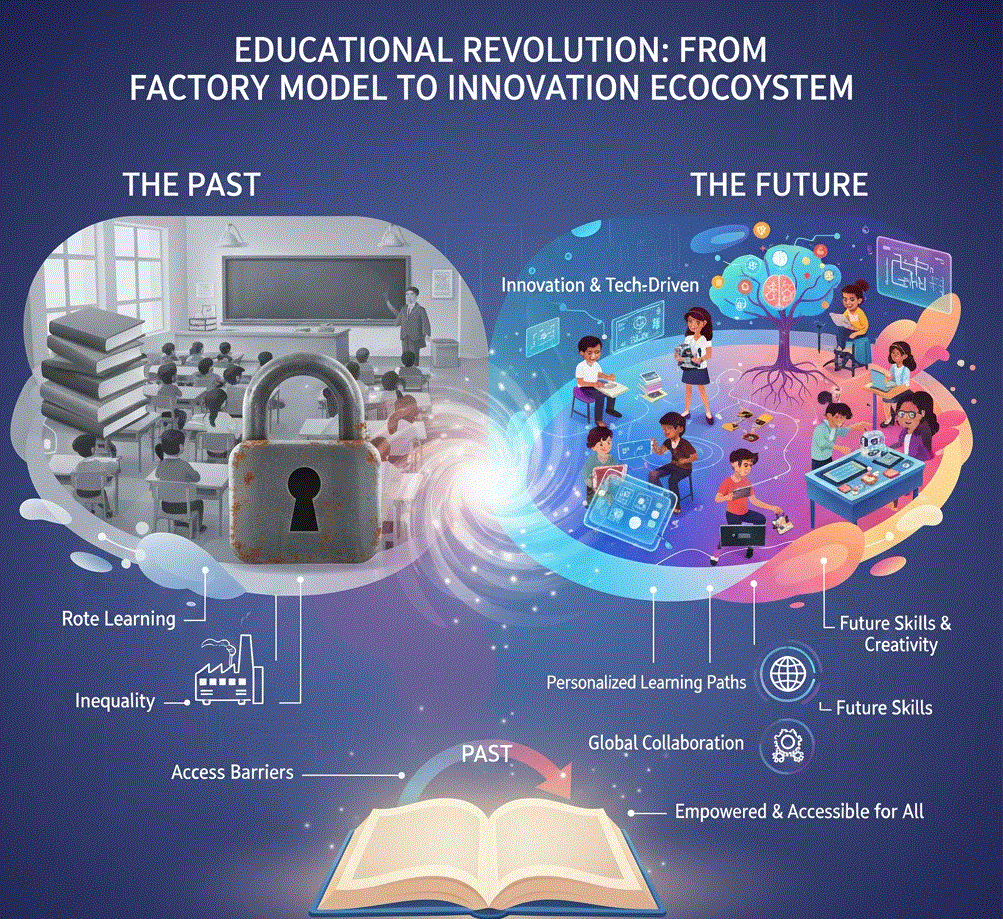
Though the current model can be called “flopped,” it has simultaneously laid a pathway for an innovative, inclusive, and future ready education system. Each continent adds its unique touch Asia with technology driven hybrid learning, Europe with holistic and sustainable education, North America with creativity and digital innovation, South America with cultural and community based learning, Africa with mobile and entrepreneurship focused models, and Oceania with flexible and well being oriented education. Adaptability, creativity, digital literacy, emotional intelligence, and lifelong learning are some of the qualities the upcoming generation will see highlighted in the new system. Education’s future is not about memorizing facts; rather, it is all about empowering learners to create a connected, inclusive, and innovative world.
About the Author