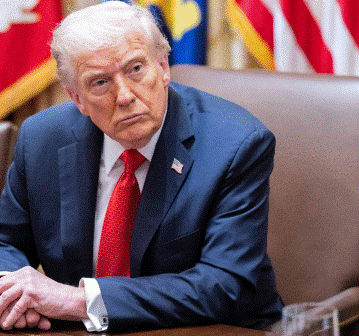
if Democrats come to power it will be a 'very bad situation': Trump
Donald Trump’s possible bid for a third term as President of the United States has again sparked furious political, legal, and constitutional controversies throughout the country and globe. In the political tradition of the United States, presidential tenures are fettered by the Twenty Second Amendment to the U.S. Constitution, which provides that no individual shall be elected to the office of President more than twice. This amendment was ratified in 1951 after Franklin D. Roosevelt served four consecutive terms during a time of global crisis, including the Great Depression and World War II. The amendment was specifically designed to prevent any future concentration of executive power in one individual for too long. Thus, the notion of Trump, or any president, running for a third term directly contradicts fundamental tenets of American democracy, with its respect for peaceful transfer of power and checks and balances. But what has been confusing is Trump’s own words. In rallies, interviews, and social media, he has consistently made statements hinting that his followers may wish him to remain beyond two terms, or that he “deserves” additional time due to supposed injustices in his first term. While his remarks have been regularly brushed away by some as political theatrics, others view them as calculated conditioning of public opinion to acquiesce to a possibly unconstitutional action. Global observers are paying close attention, as the consequences of such an action could destabilize global norms for democratic transition. The U.S. has traditionally been a world leader on democracy, leaning on other nations to adhere to term limits and election integrity. If the U.S. president himself questions these limits, it might embolden other authoritarian leaders globally to further extend their stays in power in the name of exceptional circumstances or popular pressure. Economically and diplomatically, Trump’s return already affects markets and geopolitical calculations. Countries like China, Russia, and Iran realign according to preconceived notions of a Trump style of leadership, which is characterized by its unpredictability, transactional diplomacy, and nationalist economic agenda. A probable third term, even as a longer-term possibility rather than an immediate legal reality, communicates to the world powers that American politics is getting into new and untested terrain. More importantly, the domestic implications within the United States are also telling. Trump’s supporters strongly feel that his leadership is essential to revive national power, economic prosperity, and rightist social norms. According to them, extraordinary circumstances—like border emergencies, economic stress, or cultural strife—merit extraordinary measures. Others see his arguments as a brazen attack on constitutional order, worried that dismantling the term limit is an incremental advance toward soft authoritarianism. Legal scholars emphasize that even if Trump claims his first term was “stolen” or interrupted, the Constitution is unambiguous: two terms are the maximum, regardless of their circumstances. The only theoretical way that Trump could continue to impact the White House after two terms would be outside the normal framework, e.g., holding another position such as Speaker of the House and then being president by succession if both the President and Vice President resigned. Although extremely unlikely, this has been bandied about in conservative circles. In the end, what makes this controversy more than theoretical is not Trump’s legal capability, but his capacity to influence public opinion. If enough of the population can be persuaded that he must remain, political pressure may force extreme measures to reinterpret or even revise the Constitution. It would take congressional and state-level backing in massive numbers, which is overwhelmingly unlikely but not impossible in a highly polarized country. In summary, Trump’s third-term talk is not merely about the ambition of one man but a wider challenge to American democratic strength. It asks a pressing question: are democratic conventions strong enough to resist populist and charismatic pressure, or will extraordinary times require exceptional rule? The world is not only observing what Trump does, but how the United States reacts to it.
What is important to understand is that why Trump’s third term talk is so disorienting isn’t merely the legality of it, but the psychology involved. Trump is an expert at emotional politics portraying himself not just as a politician, but as a movement, a symbol of revolution against what his voters see as a rigged system. Most of his voters truly think that normal rules do not apply to him because his presidency is a struggle for survival a belief that stretches the limits of standard democracy. Social media has magnified this feeling on an unprecedented scale in the history of administrations. Sites such as Truth Social, X, and self-sustaining conservative news websites act as echo chambers affirming Trump as singularly anointed, divinely appointed, or historically unique. In these circles, the idea of constitutional boundaries is framed not as holy law, but as a barrier erected by “the establishment.” This is where the potential risk comes in: not so much with Trump’s capacity to override the law by him, but with the normalizing of the notion that laws are up for bargaining if your candidate is sufficiently popular.
Republican officials have been very measured and calculated in deflecting the third term narrative. Some do so quietly to fuel the sentiment and energize Trump’s base, while others brush it off humorously to avoid derailing into controversy. Democrats meanwhile call Trump’s language a warning signal that was akin to initial changes in nations such as Turkey, Venezuela, or Russia, wherein their leaders gradually tested people’s tolerance before actually extending their authority. American democracy has always worked on the premise that presidents will uphold social norms even when the law must be pushed to the limit but Trump seems happy to challenge the norms themselves, and so the future is uncertain. One might agree or disagree with him, but there is no denying Trump is rewriting the political communications rulebook.
Economically, Trump in the political field immediately impacts world markets. Investors watch not only for policy, but tone. Under deregulation and tax reform during his last term, Wall Street prospered, but also endured turbulence from trade wars and aggressive tariffs. Third term discussion suggests continuing a harder nationalist economic course. This takes strength from American business and working class voters in swing states such as Ohio, Michigan, and Pennsylvania, who feel left behind by decades of globalist trade policy. But business leaders are concerned that institutional uncertainty challenging the Constitution itself may unleash long term volatility in international confidence in U.S. governance.
What makes this story even more fascinating is the way in which generationally polarized Americans are. Older conservatives see Trump as a needed shake-up amidst a time of cultural transformation, but the younger voters and many Republicans are finding interest in new leadership such as Vivek Ramaswamy or Ron DeSantis. For Gen Z, the notion of a president trying to remain in office for more than eight years seems disorientingly anti democratic, irrespective of ideology. But at the same time, Gen Z has the lowest level of trust in institutions ever, so they are neither a set of apologists for the system nor necessarily. They simply desire change maybe minus the chaos.
Ultimately, whether Trump actually tries to run a third term or not is secondary to what kind of environment makes such a question even plausibly serious. It portends a seismic shift in the way Americans think about power, law, and leadership. The American political system is confronted with an age where charisma could supplant the Constitution, and where allegiance could trump law. The next few years will challenge not only Trump’s aspirations, but the resilience of the democratic culture itself a test that will be observed not only by Americans, but by all nations assessing the future of global democracy.
About the Author