Quentin Tarantino Criticizes Paul Dano: “Weak Sauce” in There Will Be Blood
Quentin Tarantino and Paul Dano have been at the heart of an unexpected controversy in 2025, in the wake of the legendary director’s public critique of Dano’s performance in the 2007 film There Will Be Blood. While that film is widely considered one of the most powerful and influential pieces of modern cinema, Tarantino’s comments rekindled a discussion about acting, directorial expectations, and the significantly subjective quality of film criticism. Tarantino himself is a director lauded for his unique voice, razor sharp dialogue, and cinematic bravado. He has never minced words about films, actors, and performances that he either likes or dislikes. Recently, though, his comments regarding Dano called his performance “weak sauce,” “uninteresting,” and the “weakest male actor in SAG,” surprising many, as Paul Dano’s performance is widely regarded as excellent and said to carry much of the tension and drama in this movie.
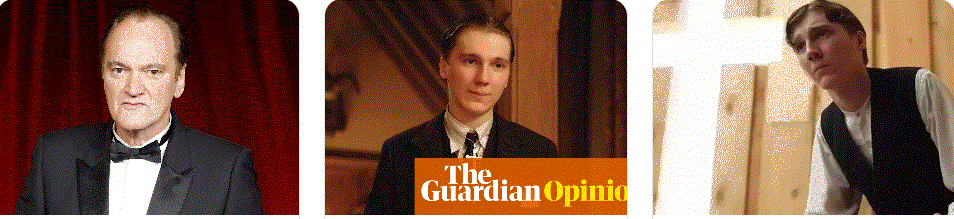
There Will Be Blood is an epic tale of ambition, greed, and moral decay set against the oil boom in California. In this film, Paul Thomas Anderson casts Dano in the dual role of the Sunday brothers, Paul and Eli. It is a challenging and nuanced performance, one that requires perfect timing, emotional depth, and the careful blending of intensity and subtlety. His performance was crucial to the overall haunting atmosphere and the complex dynamics between the characters in the film, especially those with Daniel Day Lewis, who won an Academy Award for his portrayal of Daniel Plainview. Indeed, many critics and fans credit Dano with holding his own against Day Lewis, thereby creating a memorable and believable presence in a film that was largely dominated by one of the finest actors of his generation.
Tarantino’s criticism, which emerged during an appearance on The Bret Easton Ellis Podcast, was blunt and unfiltered. While Tarantino listed There Will Be Blood in his top 20 films of the 21st century, he pinpointed Dano’s performance as one of the major reasons the film did not rank higher, saying it really should have starred someone like Austin Butler in the role. The perspective has been contentious, as it runs against the broader consensus of the film and Dano’s contribution to its success. Film scholars, critics, and audiences have interpreted and contextualized Dano’s performance for decades as multilayered and riveting; many find it integral to why the movie is a modern masterpiece.
The reaction to Tarantino’s remarks has been mixed but largely defensive of Dano. Social media erupted with film enthusiasts and critics weighing in, some mocking Tarantino’s hyperbolic description, while others defended Dano’s craft and his ability to deliver a nuanced performance under intense pressure. Many pointed out that Dano’s portrayal of Eli Sunday is purposefully restrained and morally ambiguous, which requires a subtle touch rather than the overt flamboyance that Tarantino seems to prefer. This debate reflects a broader discourse in cinema about what constitutes a “good” performance and how personal taste and stylistic preferences influence even the most respected directors.
With a penchant for strong, larger than life characters and dialogue driven storytelling himself, Tarantino seems to favor highly expressive, witty, and theatrical performances. By contrast, Dano adopts an understated, naturalistic approach in There Will Be Blood, where meaning demands patience and attention from the audience. According to some film analysts, the critique by Tarantino can perhaps come because of the stylistic approach, emphasizing that maybe Tarantino values charisma and boldness more than the quiet, simmering tension that Dano brings to his role. Indeed, comparisons among the two do bring into sharp relief an essential tension in cinema the balance between subtlety and spectacle, restraint and drama. Dano’s work in the movie stands as an exemplar of the former; Tarantino’s movies are an exemplar of the latter. Hence, the critique has more to do with personal taste than with objective judgment of talent.
This leads to another aspect of the controversy, which is a question of the unique career trajectories of both men. Tarantino, as a filmmaker, has consistently been recognized for his ability to craft memorable characters, often relying on intense, sometimes exaggerated performances to drive his narratives. His films, from Pulp Fiction to Kill Bill, are largely exercises in dialogue, timing, and performative theatricality. Dano, on the other hand, has carved out a niche as a versatile and thoughtful actor, capable of inhabiting complex, often morally ambiguous characters with subtle precision. Roles in films like Little Miss Sunshine, Prisoners, and Love & Mercy illustrate his range and commitment to depth over spectacle. The divergence in their approaches to performance inevitably frames the debate over Dano’s role in There Will Be Blood, illustrating how differing artistic philosophies can take shape within critical reception.

This discussion also evidences the critical relevance of There Will Be Blood almost twenty years after it was first released. The film stands as a cinematic benchmark in its amalgamation of narrative depth, atmosphere generated through cinematography, and powerful performances. Dano’s playing the dual role of Paul and Eli Sunday remains studied in film schools and referenced in critical discussions around his ability to generate tension, moral complexity, and narrative drive without overpowering the central protagonist. The critique by Tarantino, although quite controversial, has involuntarily driven interest in critical analyses of Dano’s performance and generated fresh commentary and debate amidst film scholars and casual viewers alike. Public responses to Tarantino’s comments have run the gamut, with some rising to Dano’s defense on the grounds of his subtlety and the ability to complement Day Lewis’s commanding presence. Others feel that even if one or two flaws could be ascribed to Dano’s performance, they were minor next to the overall brilliance of the film. The discussion underlines in many ways how film evaluation is subjective what sounds compelling and masterful to one viewer can be felt to fall short by another. The conversation also points out the challenges actors face when performing alongside legends in Dano’s case, matching Daniel Day Lewis in intensity required restraint, timing, and subtle nuance regarding character interplay, qualities that viewers might bypass for more overt dramatics. Beyond the immediacy of the debate, Tarantino’s comments reveal the effect of the film industry and the character of celebrity critique. Even the most highly regarded directors are given to statements that are bold, polarizing, and sure to raise public debate and change perceptions of works that are long standing. The same goes for actors; no matter how well appreciated they may be, their performances could be looked at through lenses that are different or face unexpected criticism. For Dano, the discourse serves as a challenge and recognition of his importance in cinema; that someone like Tarantino would feel moved to comment on the topic is proof that his work has made a lasting impression. Ultimately, the spat between Quentin Tarantino and Paul Dano is less about right versus wrong and more about the diversity of taste, interpretation, and artistic vision. It stands as an example of how cinema, even to this day, continues to provoke discussion and even disagreement among its most intimate creators. Tarantino’s critique, Dano’s understated brilliance, and the public’s divided reaction create a richer understanding of the nuances of performance, the subjectivity of critique, and the lingering impact of a movie like There Will Be Blood. By stirring up new conversation, the incident reassures one of the long standing strengths of cinema: the ability to incite passion, debate, and consideration, while showcasing the enduring artistry of the actors at play and the persisting relevance of intelligent discourse on film. In all, Quentin Tarantino’s 2025 critique of Paul Dano in There Will Be Blood encapsulates the interesting interplay between directorial opinion, audience perception, and critical reception. While Tarantino lambasted Dano’s performance as weak and suggested who he would have cast instead, Dano’s subtle, multilayered performance remains hailed as one of the best works of his career. The debate underlines the subjectivity inherently attached to film performance criticism and underlines the differences between acting styles, directorial preferences, and audience expectations. At the same time, it reinstates the continuing relevance of There Will Be Blood within cinematic discourse, extending an invitation to new generations to engage with, analyze, and appreciate a film that remains a landmark achievement nearly two decades after its release. The exchange between Tarantino and Dano is a reminder that even in an art form as celebrated and analyzed as cinema, disagreement, discussion, and debate are not only inevitable but also crucial to understanding the evolution of storytelling, performance, and artistic vision.
About the Author