A Regional Web of Violence
The three incidents you mention the suicide bomb outside the district court in Islamabad, the cross border drone and gun attack that killed Chinese workers in Tajikistan, and the fatal shooting of U.S. National Guard members in Washington, D.C. are powerful and disturbing events that together illustrate a fracturing and highly interconnected security environment. However, at present there is no verified evidence that they are causally linked or part of a single coordinated campaign; rather, the most responsible way to read them is as contemporaneous manifestations of different, overlapping problems: resilient domestic insurgency in Pakistan, the spillover of violence from Afghanistan into its neighbors, and isolated acts of lethal violence within the United States that nevertheless have international political consequences. The Islamabad attack on 11 November 2025 was a suicide bombing outside the District Judicial Complex that killed a dozen people and was claimed by a faction of the Pakistani Taliban, an incident underlining Pakistan’s ongoing internal insurgency and the vulnerability even of heavily trafficked civic institutions to militant violence.
The attack that killed three Chinese nationals in Tajikistan was reported to have been a drone and gun attack launched from across the Afghan border a stark example of how militant or criminal violence emanating from Afghanistan’s territory can reach third countries and foreign nationals working there. According to Tajik authorities, drones and firearms targeted a workers’ camp, while several reports tied the origin of the assault to Afghanistan.
The Washington, D.C. shooting at the end of November 2025, allegedly carried out by an Afghan national who previously worked with U.S. actors, resulted in one National Guard soldier’s death and increased the U.S. domestic political debate about immigration, vetting, and the wider geopolitics of the region.
Taken together, these incidents reveal several converging themes even if they do not prove operational linkage: first, transnational risk that violence emanating from one country today routinely affects actors and locations well beyond that state’s borders foreign workers in Central Asia, judicial institutions in Pakistan’s capital, and communities in Western capitals reveals the porous nature of conflict zones today. Second, attribution and the politics of blame states under pressure often respond to an attack by naming external actors or safe havens, and such accusations can quickly ratchet up tensions between neighbors or between major powers; the public naming by Pakistan of cross border complicity or external responsibility for jihadist operations and the identification by Tajikistan of an attack vector from Afghan soil are politically consequential claims meriting careful, evidence based investigation.
Third, adaptation and lowering of the threshold of violence: using low cost unmanned aerial vehicles to deliver explosives or to conduct target strikes, combined with small cell suicide tactics and shootings by so called lone actors, illustrates ways in which adversaries put methods and platforms together that complicate traditional defensive measures air defenses suitable for state level conflict, for example, are often mismatched to swarm able drones, whereas police and court security can be overwhelmed by a determined suicide attacker. The prevalence of drones in the most recent conflicts whether in the South Caucasus or in Afghanistan and Central Asia helps explain why remote, deniable attacks have become more common and harder to attribute rapidly.
Fourth, the asymmetric political reverberations: the D.C. shooting, though geographically far from South Asia and Central Asia, has immediate policy consequences in the United States and feeds domestic political narratives that can influence international cooperation on counterterrorism; similarly, attacks that kill foreign nationals such as the Chinese victims in Tajikistan strain bilateral relations, spur demands for stronger cross border security cooperation, and can affect investment and economic projects in the region.
Fifth, the analytical caveat: notwithstanding superficial similarities in violence, the apparent use of unconventional delivery systems, and the involvement of actors with links to Afghanistan, there is currently no credible, publicly available intelligence or investigative journalism linking the Islamabad bombing, the drone strike against Chinese workers in Tajikistan, and the shooting in D.C. into a single directed campaign by one group or state. Media coverage, official statements, and open source reporting treat these as separate incidents with distinct perpetrators, motives, and local contexts; conflating them risks both analytical error and the political manipulation of fear.
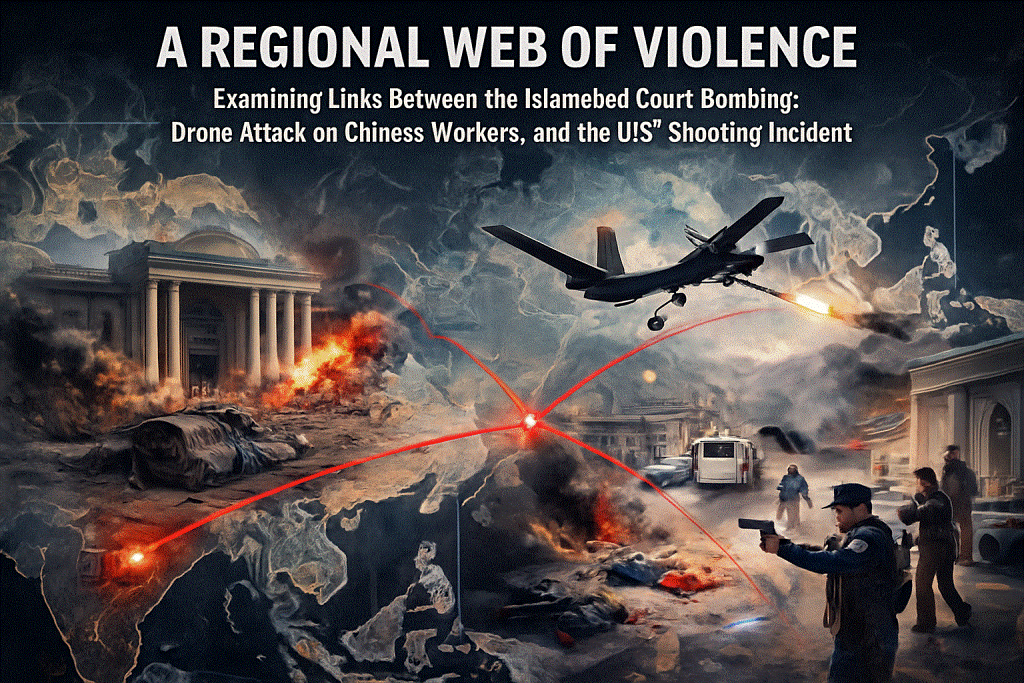
Where observers sometimes misread coincidence for causation is in the temptation to draw grand strategic narratives from isolated events: for instance, pointing to Pakistan’s internal instability as a cause for its foreign policy choices, or arguing that foreign actors orchestrate domestic attacks to provoke geopolitical outcomes; such narratives can be politically seductive but require solid, classified evidence if they are to be at all credible. Instead, a more defensible argument is that these events are symptomatic of wider systemic problems regional governance vacuums, contested borderlands, proliferation of drone technology to non state actors, and fractured migration and asylum systems each of which lowers the energy barrier to violence and raises the probability that disparate incidents will occur in temporal proximity. Policy responses therefore need to be multi layered: home security reforms and judicial protection measures in Pakistan to harden civic targets; regional intelligence sharing and border management among Afghanistan’s neighbors and China to reduce cross border strike capacity; multilateral frameworks to control illicit transfer and weaponization of drones; and careful, law based immigration and vetting policies in democracies balancing security with human rights. Finally, the human cost lost lives, disrupted communities, and strained interstate trust demands humility from analysts and responsible restraint from policymakers: sensational or premature linkage claims can inflame nationalism, justify disproportionate measures, or distract from painstaking, evidence based investigations needed to hold perpetrators to account and prevent future attacks. To sum up, while the Islamabad court bombing, the cross border drone attack that killed Chinese workers in Tajikistan, and the U.S. National Guard shooting form part of a disturbing global pattern of diffuse, technologically enabled violence, they remain, based on public reporting to date, distinct episodes; the most valuable approach is to regard them as related only insofar as they reflect common vulnerabilities and policy failures not as proven pieces of a single, orchestrated campaign and to press for open investigations and international cooperation to deal with root causes and technologies that enable such attacks.
About the Author