IAF Tejas Fighter Jet Crash in Dubai: Full Report, Investigation Updates, and Possible Causes (2025)
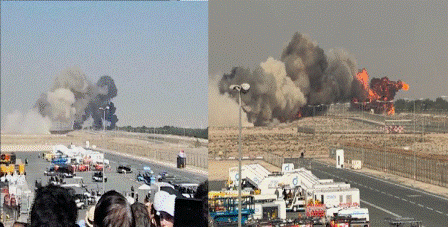
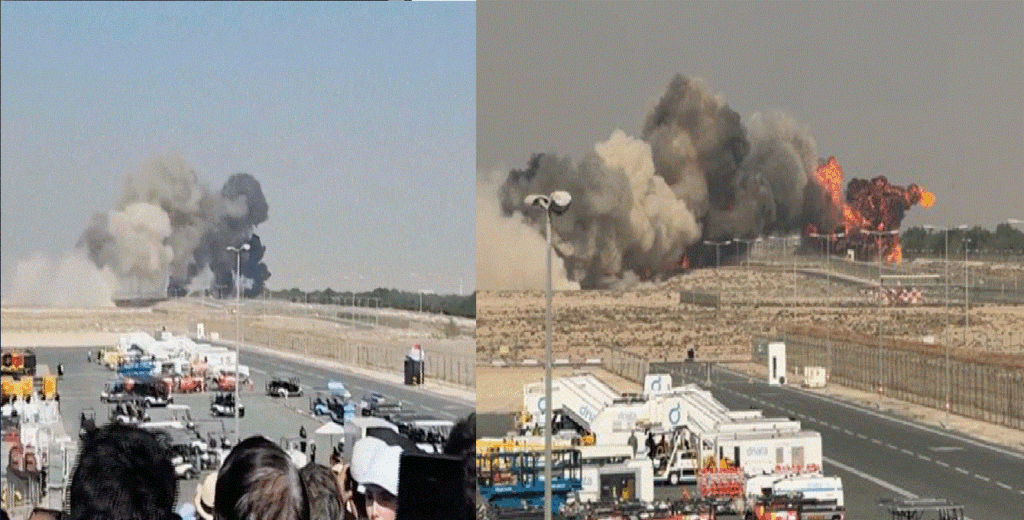
The crash of the IAF Tejas fighter jet in Dubai has become a major talking point across the world, trending on Google Search, defense websites, and social media platforms. The incident occurred during a rehearsal session for the Dubai Air Show 2025, where aircraft from across the globe move to show off their latest technologies. Early reports from eyewitnesses and official sources state that, in the middle of a high-precision maneuver, the Indian Air Force’s Tejas Light Combat Aircraft suddenly lost stability and crashed into an open area near the practice zone. The said aircraft was part of India’s publicity lineup, meant to showcase indigenous defense capabilities before a large number of international audiences. Emergency response teams in Dubai arrived in minutes, while the pilot managed to eject safely before impact; he sustained injuries but was quickly taken to a military hospital for advanced treatment. The accident has therefore raised serious questions not only about the immediate cause but also about the aircraft’s technical reliability, global perception, and the wider implications for India’s defense manufacturing program.
Both Indian and UAE authorities launched a joint investigation into what precisely went wrong in the aftermath of the crash. A specialized inquiry committee comprising IAF engineers, HAL technicians, UAE aviation regulators, and independent flight safety experts has started analyzing debris from the crash site, flight control logs, engine status reports, and the pilot’s testimony. High-resolution satellite images and radar data are also being analyzed to reconstruct the last seconds before the Tejas went down. Though the final investigation report is still awaited, preliminary assessments point toward the possibility of a sudden technical malfunction. Experts say that the Tejas, like all advanced fighter jets, depends on seamless coordination between aerodynamic design, engine output, avionics, and its complex fly by wire system. Even a minor failure in one subsystem whether related to the engine, flight control sensors, hydraulics, or electrical circuits can become catastrophic when the aircraft is operating at high speeds and extreme angles of attack during an air-show routine.
One of the most discussed theories, with regards to the Tejas mishap, involves a possible engine failure. The Tejas runs on a GE F404 IN20 turbofan engine-a highly reliable unit with widespread use on several fighter platforms of the world. However, no engine is completely immune to sudden loss of power, compressor stalls, or overheating under extreme conditions. Eyewitnesses reported an unusual sound coming from the aircraft moments before the crash, which analysts interpreted as a probable engine surge or flameout. Given that air show maneuvers often push engines to their limits, excessive heat generation, rapid throttle changes, or micro mechanical inconsistencies remain under close scrutiny by the investigation team for their potential to have triggered the surprise failure.
Another key focus area is the aircraft’s flight control system. Tejas employs an advanced, fully digital fly by wire system designed to keep the aircraft stable despite its inherently unstable aerodynamic configuration. A glitch in the flight control computers, inconsistency in sensor input, or electrical interruptions of any kind can make it unstable all of a sudden. Though HAL has time and again assured that the Tejas flight control software meets global safety standards, system logs are being analyzed in depth by investigators to rule out any anomalies.
Environmental factors are also being studied, including the extreme heat and air density in Dubai. Rehearsals for the air show typically operate at low altitudes with steep climbs and rolls and turns with heavy aerodynamic loads imposed on the aircraft. High temperatures can affect engine efficiency, fuel density, lift generation, and overall aircraft performance. The Tejas has been tested in hot weather conditions in India, but the unique desert environment of Dubai characterized by pockets of heat, turbulence, and rapidly changing wind currents might have added stress to the flight.
The crash has led to pitched debate within both defense and aviation communities. Some experts say the incident shouldn’t blind one to the big picture on Tejas, citing that even world-class jets like the F-16, F-35, Su-30, and Euro fighter Typhoon have crashed at various exhibitions. Others believe the incident indicates that pre show checks need to be much more rigorous, pilots much better trained for air show maneuvers, and systems continuously upgraded. The Indian Ministry of Defense issued a statement requesting restraint on speculation and circulation of unverified information regarding the investigation, stating it would distort public perception and shake confidence in indigenous defense programs.
Social media has played a significant role in amplifying attention to the crash. Several videos, recorded by onlookers and staff in the vicinity, have been in circulation, showing the aircraft’s descent and its explosion. While these pieces of footage give one context, defense authorities urged users to desist from spreading misleading edits or inappropriate commentary on such visuals. The IAF also sent out an assurance that all other Tejas aircraft are fully operational and routine flight operations continue unabated. For India, the incident has strategic and commercial implications. The Tejas is a flagship product under “Make in India” and “Atmanirbhar Bharat,” signifying India’s aspiration to minimize dependence on foreign arms imports and emerges as a globally competitive arms seller. Traditionally, the Dubai Air Show has been a window for countries to display their aircraft in a bid to attract prospective foreign buyers. With several countries considering Tejas for procurement, the crash is likely to have a temporary impact on export prospects. But according to defense analysts, a single isolated accident is unlikely to impact long-term interest unless the investigation points to a flaw in fundamental design. Meanwhile, attention also stays with the pilot, who is recuperating after having ejected seconds before the crash. Flying in an air show involves very extreme risk and requires immense skill, precision, and mental focus. Because the forces are so great, ejection injuries can be quite serious; however, according to reports, the pilot was receiving complete medical treatment and should recover fully. Counseling and psychological support are also usual protocols in cases like these, as such situations often leave lasting emotional and mental impact on those who survive a crash. As both India and the UAE continue their investigation, the world waits for the final report to provide a categorical explanation for what actually caused the IAF Tejas crash in Dubai. Whether the cause identified is a technical malfunction, environmental influence, or pilot related factor, or a combination of multiple variables, the incident will no doubt add many lessons to the aviation community. Military aviation is inherently risky, but every incident provides an opportunity to further reinforce safety protocols, enhance aircraft reliability, and improve pilot training. This crash has been a landmark incident not only for the IAF but for the global aerospace industry, where technological ambitions meet operational safety. It is the final investigation findings that will shape the future of air show participation, aircraft upgrades, and international defense collaborations.
About the Author