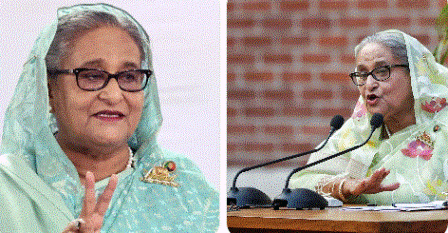
Sheikh Hasina Wajid
Sheikh Hasina Wajid, known simply as Hasina, is one of the most consequential and polarizing political figures in South Asia over the last three decades. Daughter of Bangladesh’s founding father, Sheikh Mujib ur Rahman, Hasina rose from the shadow of a traumatic family history to lead her country through periods of rapid economic growth, sharp political polarization, and finally, violent upheaval that cost her the premiership. A special tribunal in Dhaka on 17 November 2025 found the ousted leader guilty of crimes against humanity for her actions that led to the deadly crackdown on student-led protests in 2024 and sentenced her to death in absentia a ruling having heavy domestic and regional consequences.
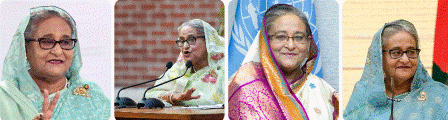
Political biography
Born in 1947 in Tungipara, the life of Sheikh Hasina has been closely linked with modern Bangladesh. Her father, Sheikh Mujib ur Rahman, led the movement for independence from Pakistan and became the nation’s first president. The political violence of 1975 when Mujib and much of his family were assassinated shaped Hasina’s early political identity and cemented her place as a chief inheritor of his political legacy. She spent years in opposition before returning to power in the 1990s; after alternating terms she consolidated a long run in office from 2009 until her ouster in 2024. Throughout those years, Hasina was credited with overseeing impressive macroeconomic growth, infrastructure expansion, and social investments that lifted millions out of extreme poverty. At the same time, critics and international rights groups accused her governments of narrowing political space, using the security apparatus to silence dissent, and presiding over abuses by elite security units.
Her record is a study in contrasts, therefore: economic modernization and international praise on one hand, accusations of democratic backsliding, symbolic electoral dominance and heavy-handed security measures on the other. Those tensions erupted dramatically during and after the student-led protests of 2024, which grew into a nationwide uprising and culminated in violent state responses that, according to multiple post crisis accounts and investigations, left hundreds and by some counts over a thousand dead. The eventual collapse of her government in August 2024 and her flight into exile marked a stunning reversal for a leader who had been Bangladesh’s longest serving prime minister.
Trial and the decision
The interim government in Dhaka made accountability for the 2024 crackdown its first order of business following Hasina’s ouster Hasina and a number of top officials were put on trial by an International Crimes Tribunal that the interim authorities converted into a body to adjudicate alleged crimes committed during the uprising. The tribunal charged Hasina as the “mastermind and principal architect” of state violence, charging her with incitement, ordering killings and failing to prevent atrocities during the protests. Hasina refused to acknowledge the authority of the tribunal, would not attend proceedings in person, and was tried in absentia after fleeing to India in August 2024.
On 17 November 2025, the court delivered its most consequential rulings: Hasina was found guilty on multiple counts of crimes against humanity and sentenced to death. The tribunal also convicted several former ministers and security officials, and in parallel proceedings the interim authorities have pursued bans on Hasina’s Awami League party and arrests of party activists. The verdict was broadcast live, and inside the courtroom some of the families of those killed during the 2024 unrest reportedly reacted with relief and applause; internationally, the decision produced immediate controversy and concerns about due process and politicization of justice.
Hasina’s response and the question of fairness
From exile, Hasina denounced the verdict as politically motivated, arguing that the tribunal was neither impartial nor independent. She called the proceedings a rigged process in which an interim government settled political scores. Human rights organizations and some legal observers have urged the new authorities to ensure full standards of fairness and warned against the use of capital punishment in politically charged cases. Supporters of the tribunal and many victims’ families counter that the judiciary is delivering long-awaited justice for mass killings that were otherwise left unpunished. That tension between demands for accountability and safeguards for fair trial rights is at the heart of international debate over the verdict.
Decision means for Bangladesh
Domestically, the sentence cements an already stark political cleavage. The interim government hails the ruling as historic justice and has made it one of the pillars of its legitimacy; opponents call it a show trial designed to eliminate a major political rival. Thus far, the immediate response has included heightened security measures, arrests of Awami League figures, and episodic unrest in Dhaka and elsewhere. For the families of the victims of the 2024 violence, the tribunal’s verdict offers some closure; for large swaths of the population that sympathized with Hasina or feared retribution at the hands of political opponents, it inspires fear and the prospect of deepening instability. Analysts warn that the government will have to delicately balance retributive justice with reconciliation, especially if the political bans and mass detentions continue.
Relation to Pakistan
The implications of Hasina’s conviction extend beyond Bangladesh. Pakistan’s relationship with Dhaka has long been fraught, rooted in the traumatic history of 1971 when the then East Pakistan broke away after a brutal war. Under Hasina’s rule, relations were often cool, complicated further by her pursuit of war crimes trials against collaborators from 1971 a policy that periodically provoked tensions with Islamabad. Yet, following her ouster in 2024, Bangladesh underwent realignment in its regional diplomacy: ties with Pakistan began to thaw as the new government sought friends and economic partners beyond traditional alignments. Analysts noted a window of opportunity for enhanced trade and cooperation between Islamabad and Dhaka in the post-Hasina period.
1. Diplomatic calculations and regional positioning. If Bangladesh’s new leadership leans toward closer relations with Pakistan, Islamabad could see strategic, economic, and political openings from textile supply chains to joint forums. But if the verdict generates protracted instability in Dhaka or forces Hasina’s allies into hostile posture, Pakistan may find itself having to navigate a more volatile neighbor. Many regional observers observed that the fall of Hasina had already started changing South Asian alignments; the tribunal verdict entrenches a new chapter whose trajectory Pakistan will be watching closely.
2. Domestic political optics: Pakistani leaders have veered between caution and opportunism in responding to the verdict. Any public position be it supportive of due process or critical of what Islamabad might call “political trials” will be parsed domestically to fit internal politics. Pakistan’s own fraught history with accountability, military influence and judicial politics means Dhaka’s developments will be used by Pakistan’s political actors to score points at home. Note: at the time of writing, official Pakistani government statements on the 17 November verdict were cautious and limited; Islamabad appears to be calibrating its response amid concerns about regional stability.
3. India as the pivotal variable. The Hasina case underlines India’s outsized influence in the region. Hasina’s flight to India in August 2024 and New Delhi’s refusal so far to extradite her is a diplomatic fault line that links Bangladesh, India, and Pakistan. For Islamabad, any move by India to square relations with Dhaka on terms India prefers may shift regional balances. Pakistan therefore watches closely whether the verdict prompts new requests for extradition, and how New Delhi responds, because those actions will reverberate across regional alliances.
Pakistan: before and after the decision
Before the verdict, Pakistan and Bangladesh had been cautiously warming ties after Hasina’s ouster. A spate of think tank pieces and commentary throughout 2025 flagged the thawing of bilateral relations, impelled by shared economic interests, diplomatic overtures and a mutual interest in diversifying regional alignments. Pakistan saw potential economic dividends from deeper engagement with Bangladesh’s booming textile and pharmaceutical sectors and saw a post Hasina Dhaka as more receptive to Islamabad’s outreach. Strategic analysts argued that a closer Pakistan–Bangladesh relationship can rebalance the dynamics of South Asia, especially vis à vis Indian influence.
After the verdict, the sentence brings in new uncertainties. Short-term effects are increased diplomatic sensitivity and the possibility of domestic spillover into Bangladesh may impact cross border trade and investment. Pakistan could accordingly assume a cautious public posture by calling for due process and avoiding overt support for Hasina while quietly guarding an ever-improving engagement with Dhaka. If the interim government in Bangladesh presses for extradition from India and internationalizes the case, Islamabad might find itself being forced to take a stand between conciliatory pragmatism and principled calls for fair trial guarantees. Moreover, if Dhaka’s internal crackdown expands; it could produce refugee flows, disruptions to supply chains, an increase in cross border political activity all elements that would concern Islamabad.
Risks to regional stability
A death sentence for a major political figure tried in absentia is an inherently destabilizing event. In addition to domestic unrest in Bangladesh, the ruling risks provoking protests in Diasporas communities, straining relations with India, and triggering diplomatic contests in multilateral fore. Pakistan sandwiched between its own security challenges and an animating competition with India – will watch for any movement that could upset trade routes or shift alliances. There is also the wider international lens: Western governments and rights groups will measure the tribunal’s proceedings against global standards, and their reactions may influence aid, investment, and diplomatic engagement with Dhaka all externalities Pakistan will be monitoring closely.
What comes next?
Legally, Hasina can seek appeals through the Bangladeshi legal system if she returns, or her legal team may attempt international legal actions arguing procedural defects. Politically, the verdict hardens the interim government’s posture-it has already banned the Awami League and arrested many of its leaders, signaling that it intends to reorganize Bangladesh’s political architecture before elections. Regionally, key players India, Pakistan, China and major Western partners will recalibrate their policies to balance stability, human rights concerns, and strategic interests. The question of extradition from India is likely to be the immediate diplomatic test: if New Delhi refuses to hand Hasina over, Dhaka-Delhi tensions will deepen, with knock-on consequences for Pakistan as it reassesses its own regional strategy.
The 17 November 2025 sentence is not only the legal coda to the 2024 crisis in Bangladesh-it is a milestone which will reshape party politics, regional diplomacy, and public memory. For well-wishers of the victims’ families, the tribunal’s verdict is a form of hard-won justice. For supporters of Hasina and many neutral observers, the verdict brings up awkward questions of fairness, victors’ justice, and the use of extraordinary penalties in fractured polities. For Pakistan, the event is a strategic variable to be managed-a chance for deeper ties if Dhaka’s politics stabilize, but a source of risk if continued upheaval destabilizes the neighborhoods. How governments, courts, and societies respond in the weeks and months ahead will determine whether this verdict becomes a step toward durable accountability or the start of a more destabilizing regional fracture.
Key sources and reporting used
- Reuters reporting on the conviction and details of the tribunal.Reuters
- Al Jazeera coverage of the trial, charges and after math. Al Jazeera
- Financial Times and The Guardian analysis of the verdict and political context.Financial Times
Regional analysis of Pakistan Bangladesh relations and the post Hasina realignment. Modern Diplomacy
About the Author